Hey friends,
Everyone is talking about Claude these days. In fact, my LinkedIn, YouTube, and X feeds are filled with posts about Claude and its models.
Some people are discussing its latest releases, while others are building incredible applications with them.
But despite all the buzz, many people still don’t understand the differences between the Claude models or which one is best for their needs.
So, in this guide, I’ll break down every Claude model in simple terms and help you choose the right one for your specific use case.
Instead of overwhelming you with technical jargon or benchmark scores alone, we’ll compare every Claude model in a way that’s easy to understand.
You’ll learn what each model is designed for, how they differ in terms of performance, speed, context window, and pricing, and which one offers the best value for different tasks.
By the end of this guide, you’ll know exactly which Claude model is best for coding, writing, research, automation, and business tasks…and how much each one costs.
Ready? Let’s dive into it…
What Are Claude Models?
Claude models are the different AI models developed by Anthropic that power the Claude AI assistant.
While all Claude models are built on the same foundation and can understand natural language like…writing content, generating code, analyzing documents, and answer complex questions, each model is optimized for different priorities such as intelligence, speed, cost, and scalability.
To make it easy, think of Claude models like different engines in the same car lineup. They all get you to your destination, but some are designed for maximum performance, some prioritize efficiency, and others strike a balance between the two.
That means, choosing the right model depends on what you’re trying to accomplish and how much you’re willing to spend.
But, Why Does Anthropic Offer Multiple Claude Models?
Well, not every AI task requires the most powerful…and most expensive AI model.
Writing a short email, summarizing meeting notes, or answering customer support queries doesn’t require the same level of reasoning as debugging a large codebase or, analyzing lengthy research papers.
To make it available for most users, Anthropic offers multiple Claude models that balance four simple factors:
- Intelligence – how well the model reasons, understands context, and solves complex problems
- Speed – how quickly it generates responses
- Cost – how much it costs to use, especially through the Claude API
- Efficiency – how well it handles large-scale or high-volume workloads
This helps developers, businesses, and everyday users the flexibility to choose the model that best matches their needs…instead of paying for capabilities they might use.
Now, let’s understand these factors and why they actually matter:
Intelligence Levels:
Claude’s model family generally falls into three performance tiers:
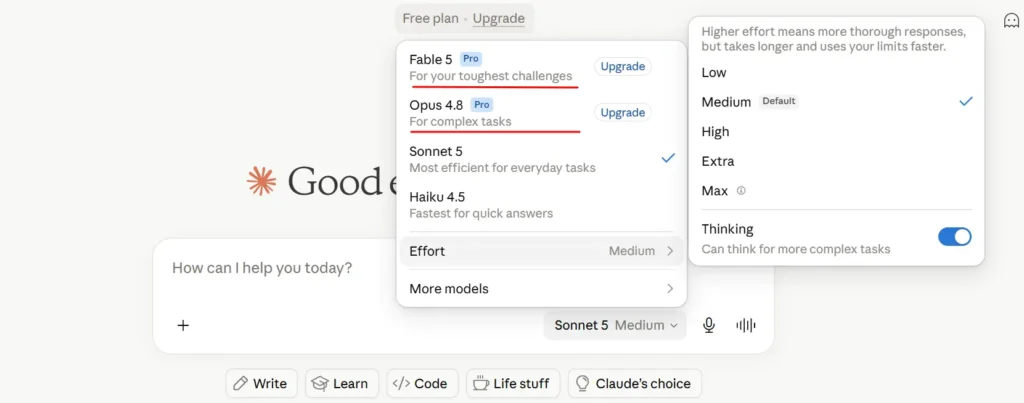
- Claude Haiku – The fastest and most cost-effective model, ideal for lightweight tasks such as summarization, classification, chatbots, and high-volume automation.
- Claude Sonnet – A model that combines strong performance, fast response times, and offer reasonable pricing, making it the best choice for most users.
- Claude Opus – The most capable model, designed for advanced reasoning, complex coding, deep research, and tasks that require the highest level of intelligence.
- Claude Fable – This model helps in creating autonomous workflows and long-running agentic tasks.
- Claude Mythos – The most advance model with state-of-the-art cybersecurity and agentic capabilities
Rather than thinking of one model as “better” than another, it’s more helpful to think of them as being optimized for different workloads.
Understanding the Speed and Cost:
One of the biggest differences between Claude models is the trade-off between performance and price.
More powerful models typically provide better reasoning, more accurate code generation, and stronger performance on complex tasks. However, they also require more computing resources, making them slower and more expensive to use through the API.
On the other hand, lighter models respond much faster and cost significantly less, making them ideal for applications that process thousands or even millions of requests each day.
As a general rule:
| If you need… | Choose a model that prioritizes… |
|---|---|
| Deep reasoning and difficult problem-solving | Intelligence |
| Everyday writing and coding | Balanced performance |
| Fast responses at the lowest cost | Speed and efficiency |
The best Claude model isn’t necessarily the most powerful one…it’s the one that delivers the right balance of quality, speed, and cost for your specific use case.
Claude App vs. Claude API
Claude models are available in two primary ways, and understanding the difference can help you choose the right option.
1. Claude App:
The Claude app is Anthropic’s ready-to-use AI assistant, available on the web and mobile devices. You simply sign in, start a conversation, upload files, generate content, or ask questions—no programming required.
Depending on your subscription (such as Free, Pro, Max, Team, or Enterprise), you’ll have access to different models and usage limits.
This option is ideal for students, writers and content creators, working professionals, researchers, and other daily AI users.
2. Claude API
The Claude API gives developers direct access to Claude models so they can build AI-powered applications, automate workflows, create chatbots, analyze documents, or integrate Claude into their own software.
Instead of paying a monthly subscription, API users are charged based on the number of input and output tokens processed, allowing businesses to scale usage according to their needs.
In short:
- Claude app is an AI assistant that’s ready to use.
- Claude API is for building applications or integrating Claude into your own products.
In the next sections, we’ll compare every Claude model in detail…including their capabilities, pricing, benchmarks, strengths, weaknesses, and the types of tasks they’re best suited for.
Current Claude Models at a Glance
Before diving into each Claude models, let me give me a quick glance and a comparison table of all active models:
| Model | Release | Speed | Intelligence | API Cost (per MTok, input/output) | Best For |
|---|---|---|---|---|---|
| Claude Haiku 4.5 | Earlier 2025-gen | Fastest | Good for straightforward tasks | $1 / $5 | High-volume, low-latency work — classification, extraction, simple Q&A, chat |
| Claude Sonnet 5 | Current gen | Fast, balanced | Strong all-around reasoning | $2 / $10 (intro pricing through Aug 31, 2026; $3/$15 after) | Everyday production work — coding, writing, analysis, most app traffic |
| Claude Opus 4.8 | Current gen | Slower | Anthropic’s top model for complex agentic/enterprise work | $5 / $25 | Long-running agentic coding, deep reasoning, enterprise-grade tasks |
| Claude Fable 5 | June 9, 2026 | Slower | Anthropic’s most capable widely released model Claude Platform Docs | $10 / $50 | Highest-capability workloads, next-gen long-running agents |
| Claude Mythos 5 | June 9, 2026 | Slower | Shares Claude Fable 5’s specs and pricing, no extra safety layer | $10 / $50 (same as Fable) | Same as Fable 5, for approved Project Glasswing customers |
| Claude Mythos Preview | Not public | — | Highest-capability, most experimental | Not publicly available | Limited to trusted orgs under Project Glasswing |
A few notes on how to read this:
- Speed and Intelligence are relative/qualitative —Anthropic doesn’t publish a single official numeric scale for these, so treat that column as “smaller/faster model → bigger/smarter model” rather than a precise ranking.
- Cost is official API list pricing (per million tokens, input/output), not what you pay in the Claude.ai app — chat plans are flat subscriptions, not per-token.
All of these are accessible via the Claude API/Platform, and you can actually switch between models mid-conversation during a particular chat if you want to compare them.
Every Claude Model Explained:
Now, let’s get deeper into every Claude model (those are active) – from strength, weakness, pricing, context window…we will discuss everything.
Claude Haiku 4.5
Haiku is Anthropic’s smallest and fastest tier. It’s built for speed and volume rather than raw reasoning depth, running at roughly 97 tokens/second as per recent records.
Strengths
- Lowest latency in the lineup – near-instant responses
- Cheapest per-token cost…ideal for scaling to millions of requests
- Surprisingly capable for its size (73% on SWE-bench Verified), a real jump from earlier Haiku generations
Weaknesses
- Falls noticeably short of Sonnet and Opus on deep, multi-step reasoning
- Smaller context window than the rest of the lineup
- Not the right choice when task quality matters more than speed or cost
Best tasks
- High-volume classification, routing, and tagging
- Real-time customer-facing chat
- Batch processing pipelines (thousands of prompts)
- Sub-agent work, where a larger model delegates simple steps to Haiku
API Cost – $1 / $5 per million tokens (input/output) — the most affordable model Anthropic offers.
Context window – 200K tokens (standard across the API and Claude.ai).
Benchmarks ~73% SWE-bench Verified; ~97 tokens/second — strong for a “fast tier” model, though below Sonnet and Opus on hard reasoning benchmarks.
Who should use it:
If you belong to a developer community, building high-throughput or cost-sensitive applications such as…chatbots, data pipelines, and any workload where good-enough quality at high speed beats maximum capability.
Claude Sonnet 5
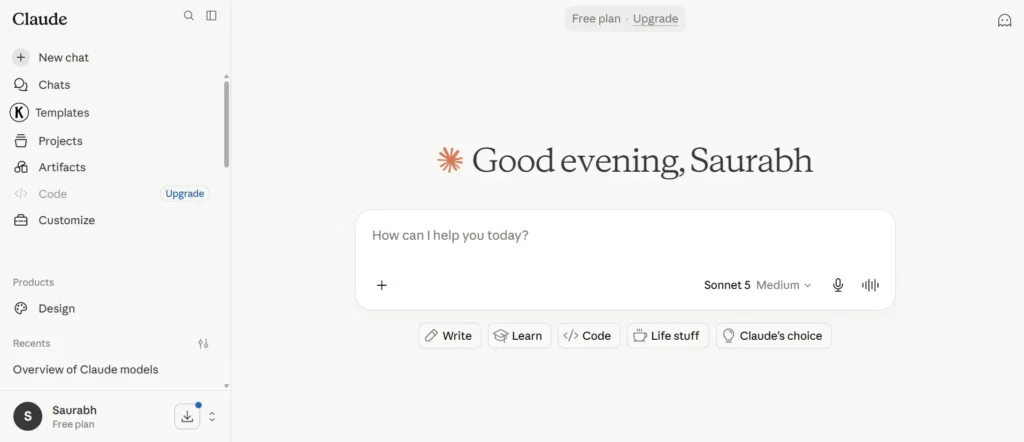
Sonnet 5 is the current mid-tier model and, as of writing, the default free model in the Claude chat.
Anthropic calls it its “most agentic Sonnet yet”…it closes much of the historical gap to Opus while staying far cheaper.
Strengths
- Near-Opus quality on most everyday tasks, including knowledge work (edges out Opus 4.8)
- Strong at long agentic task chains — holding context and self-correcting after failed tool calls
- Much better price-to-performance ratio than Opus
Weaknesses
- Still trails Opus 4.8 on the hardest coding and reasoning tasks (SWE-bench Pro, HLE without tools)
- Uses a newer tokenizer that produces more tokens per prompt than older Sonnet versions, so effective cost can rise even though the per-token rate is lower
- Deliberately kept at lower cyber capability than Opus, which matters for accuracy-critical security work
Best tasks
- Everyday coding, writing, and analysis
- Most production application traffic
- Long, multi-step agentic workflows that don’t require frontier-level reasoning
Cost – $2 – $10 per million tokens (introductory, through August 31, 2026), moving to $3 – $15 standard pricing after that.
Context window – 1M tokens, with a 128K output cap (up to 300K output via the Batch API extended-output beta).
Benchmarks – SWE-bench Pro 63.2%, OSWorld-Verified 81.2%, Terminal-Bench 2.1 80.4%, HLE (with tools) 57.4%, GDPval-AA v2 1,618 Elo — all improvements over Sonnet 4.6, and within a few points of Opus 4.8 on most measures.
Who should use it:
Claude Sonnet is default choice for most developers and everyday users – coding, research, writing, and support work where you want near-flagship quality without flagship pricing.
Claude Opus 4.8
Opus 4.8 is Anthropic’s flagship model for the “classic” lineup – the strongest choice when a task genuinely needs the deepest reasoning available short of the Mythos tier.
Strengths
- Leads the lineup on the hardest coding tasks (SWE-bench Pro, SWE-bench Verified)
- Best-in-class on olympiad-level math and computer-use benchmarks
- Highest raw reasoning score without tool assistance (Humanity’s Last Exam, no-tools)
Weaknesses
- Significantly more expensive than Sonnet 5, without always meaningfully better output on everyday tasks
- Slower than Sonnet and Haiku
- Not included on the Claude.ai Free tier
Best tasks
- Complex, multi-file software engineering and architecture decisions
- The longest, hardest agentic workflows (e.g., compliance automation, deep research chains)
- Scientific or, mathematical reasoning at the frontier level
Cost – $5 / $25 per million tokens (input/output).
Context window – 1M tokens, 128K output cap.
Benchmarks – SWE-bench Verified 88.6%, SWE-bench Pro 69.2%, USAMO (olympiad math) 96.7%, OSWorld-Verified 83.4%, Terminal-Bench 2.1 74.6%, HLE no-tools 49.8%.
Who should use it:
Teams and individuals working on the hardest coding problems, enterprise-grade agentic systems, or research-level reasoning tasks where quality matters more than cost.
Claude Fable 5
Fable 5 is Anthropic most capable widely released model – the first of the new “Mythos” tier sitting above Opus. It launched June 9, 2026.
Strengths
- Highest published benchmark scores of any generally available Claude model
- Built for next-generation, long-running autonomous agents
- Same underlying model as Mythos 5, but with additional safety measures for biology, cybersecurity, and LLM R&D
Weaknesses
- Roughly double the cost of Opus 4.8
- Was briefly suspended (June 12–30, 2026) due to U.S. export controls; access has since been restored (July 1, 2026)
- Overkill for routine tasks — the cost premium only pays off on genuinely hard, long-horizon work
Best tasks
- The hardest long-horizon coding and agentic tasks
- Workloads where the highest available capability justifies 2x the price of Opus
Cost – $10 / $50 per million tokens (input/output).
Context window – 1M tokens (in line with Opus 4.8 and Sonnet 5).
Benchmarks – SWE-bench Verified ~95.0%, SWE-bench Pro ~80.3% – both meaningfully ahead of Opus 4.8.
Who should use it:
Teams pushing the frontier of agentic coding or research who need maximum capability and can absorb the higher per-token cost.
Quick Note:
Claude Fable/Mythos: both launched June 9, 2026, were briefly suspended June 12–30 due to U.S. export controls, and access was restored July 1, 2026.
Claude Mythos 5
Mythos 5 shares the same underlying model, specs, and pricing as Fable 5, but without Fable’s additional safety layer for biology, cybersecurity, and LLM R&D.
It’s offered in limited availability, not general release.
Strengths
- Same top-tier capability as Fable 5
- Without Fable’s extra guardrails, useful for approved partners with legitimate need for the unrestricted variant
Weaknesses
- Not available to the general public – requires approval through Anthropic, AWS, or Google Cloud account teams
- Same cost and export-control exposure as Fable 5 (also suspended June 12–30, 2026, restored July 1)
Best tasks
Same frontier-level use cases as Fable 5, for organizations specifically approved for the fewer-guardrails variant.
Cost – $10 / $50 per million tokens (same as Fable 5).
Context window – 1M tokens.
Benchmarks – Effectively identical to Fable 5 (same underlying model).
Who should use it:
As you know, Claude Mythos 5 is Anthropic most powerful, unrestricted frontier model, designed exclusively for highly specialized scientific, biological, and cybersecurity research.
Because it lacks the safety guardrails present in standard AI, access is strictly limited to approved organizations through Anthropic Project Glasswing.
Claude Mythos Preview
The newest and most experimental model, sitting above even Fable 5 and Mythos 5. It is not available to the public.
Strengths / Weaknesses / Benchmarks Not publicly disclosed.
Best tasks – Currently used by a small number of trusted organizations as part of Anthropic Project Glasswing.
Context window – Not publicly disclosed.
Who should use it – Nobody outside the small set of Project Glasswing partners…this model isn’t accessible through any public product or API.
Claude Models Comparison
Here’s the full comparison table:
| Feature | Haiku 4.5 | Sonnet 5 | Opus 4.8 | Fable 5 | Mythos 5 |
|---|---|---|---|---|---|
| Intelligence | Good — solid for its size, not frontier-level | High – near-Opus on most tasks | Very high – top of the “classic” lineup | Highest publicly available | Same as Fable (no extra safety layer) |
| Coding | Decent (SWE-bench Verified ~73%) | Strong (SWE-bench Pro 63.2%) | Excellent (SWE-bench Pro 69.2%, Verified 88.6%) | Best available (SWE-bench Pro ~80.3%, Verified ~95%) | Same as Fable |
| Writing | Good for straightforward copy | Excellent, near-Opus quality | Excellent, nuanced | Excellent | Same as Fable |
| Math | Moderate | Strong, a step below Opus | Excellent (USAMO 96.7%) | Anthropic’s strongest | Same as Fable |
| Reasoning | Good for everyday logic, weaker on hard multi-step problems | Strong, ties Opus with tools (HLE 57.4%) | Excellent, best no-tools score (HLE 49.8%) | Frontier-level | Same as Fable |
| Long Context | 200K tokens | 1M tokens | 1M tokens | 1M tokens | 1M tokens |
| Speed | Fastest (~97 tok/s) | Fast, balanced | Slower (deliberate, deep reasoning) | Slower | Slower |
| API Cost | $1 / $5 per MTok | $2 / $10 intro (then $3 / $15) per MTok | $5 / $25 per MTok | $10 / $50 per MTok | $10 / $50 per MTok |
| Multimodal | Yes (text, image, PDF) | Yes (text, image, PDF) | Yes (text, image, PDF) | Yes (text, image, PDF) | Yes (text, image, PDF) |
| Tool Use | Capable, best for simple tool chains at scale | Strong (OSWorld 81.2%, Terminal-Bench 80.4%) | Excellent, best computer-use scores (OSWorld 83.4%) | Excellent | Same as Fable |
| Agent Tasks | Good as a sub-agent for simple delegated steps | Very strong — built to be “most agentic Sonnet yet” | Excellent for long, complex agentic chains | Built for next-gen long-running autonomous agents | Same as Fable, fewer guardrails |
| Best For | High-volume, low-latency, cost-sensitive tasks | Everyday default — best value | Hardest coding/reasoning, enterprise-grade work | Frontier work justifying 2x Opus cost | Approved partners needing Fable capability without extra safety layer |
Note: Mythos 5 access is limited to approved partners, not general availability – its row is functionally identical to Fable 5 on capability since they share the same underlying model.
Claude Pricing (Web & API)
Now, let’s get deep into Claude Pricing and the plans they offer:
Claude Web Plans
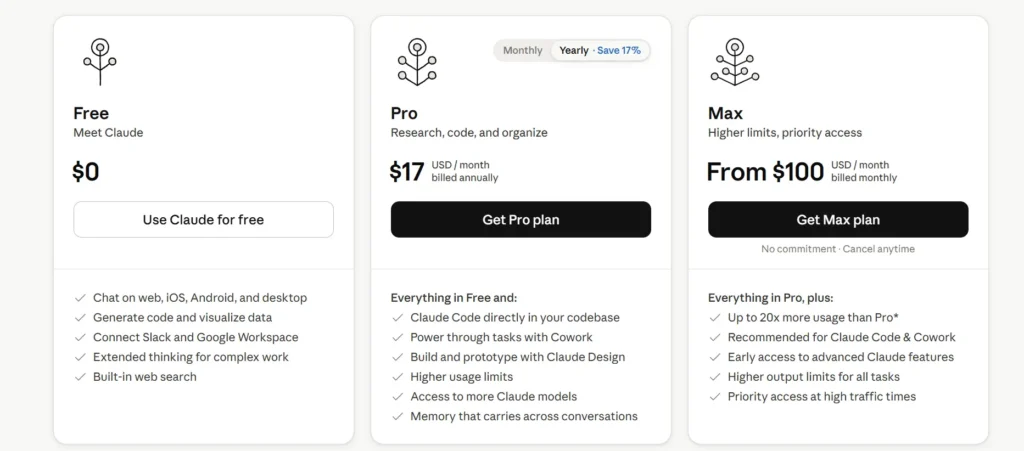
Free plan:
No cost, no credit card required to access Claude. You can freely use Claude on web, iOS, Android, and desktop.
With free models, you can generate code, write and edit content, search the web, use memory across conversations, create files, and connect Slack/Google Workspace.
Pro Plan – $17/month (billed annually) or $20/month (billed monthly)
Everything in Free, plus meaningfully more usage, and it unlocks Claude Code, Claude Cowork, Claude Design, Claude Science, unlimited Projects, Research, access to more models, and Claude for Microsoft 365.
Note: This is the plan most individual professionals land on.
Max Plan – from $100/month
Everything in Pro, plus a choice of 5x or 20x more usage than Pro (the 20x tier runs $200/month), higher output limits, early access to new features, and priority access during high-traffic periods. Built for people who regularly bump into Pro’s usage ceiling.
Team — $20/seat/month (Standard) or $100/seat/month (Premium)
For groups of 5–150 people. Standard seats get more usage than Pro; Premium seats get 5x more usage than Standard.
Both include Claude Code, Cowork, Design, and Science, plus central billing, SSO, admin controls, and no model training on your content by default. You can mix Standard and Premium seats on one account.
Enterprise — $20/seat + usage at API rates (custom pricing)
This plan is for large organizations. All Team features plus admin-set spend limits, SCIM, audit logs, a compliance API, custom data retention controls, network-level access control/IP allow listing, and a HIPAA-ready offering.
Available self-serve or through a sales-assisted contract for more tailored terms (MSA, volume commitments, etc.)
Claude API Pricing
| Model | Input | Output | Cache (Write / Read) | Batch API |
|---|---|---|---|---|
| Fable 5 | $10 / MTok | $50 / MTok | $12.50 / MTok / $1.00 / MTok | 50% off standard rates |
| Opus 4.8 | $5 / MTok | $25 / MTok | $6.25 / MTok / $0.50 / MTok | 50% off standard rates |
| Sonnet 5 | $2 / MTok* | $10 / MTok* | $2.50 / MTok* / $0.20 / MTok* | 50% off standard rates |
| Haiku 4.5 | $1 / MTok | $5 / MTok | $1.25 / MTok / $0.10 / MTok | 50% off standard rates |
Note: Sonnet 5’s rates are introductory pricing through August 31, 2026 – standard pricing after that is $3 input / $15 output per MTok, with cache write/read scaling proportionally.
What each metric means:
- Input – the price per million tokens (MTok) you send to the model: your prompt, system instructions, and any context (documents, conversation history, tool results). Tokens are roughly ¾ of a word on average in English.
- Output – the price per million tokens the model generates back to you. Output is priced higher than input across every model, since generation is more computationally expensive than reading.
- Cache (Write / Read) — prompt caching lets you store a chunk of context (like a long system prompt or document) so repeated calls don’t have to reprocess it from scratch. Write is what you pay the first time content is cached (a premium over standard input price, since Anthropic has to build the cache). Read is what you pay on subsequent calls that reuse that cached content – dramatically cheaper (often ~90% less than input) because the model reads from cache instead of reprocessing.
- Batch API — a 50% flat discount across input, output, and cache rates for asynchronous workloads that don’t need an immediate response. Anthropic processes batch requests within 24 hours, making it ideal for bulk jobs like data enrichment, content generation pipelines, or large-scale evaluation where real-time latency doesn’t matter.
Performance Benchmarks
Benchmark scores only matter if you know what they translate to in real use.
A number like “SWE-bench Pro 69.2%” doesn’t tell you what actually changes when you use the model….Below, each benchmark area is explained in terms of what it measures and what the score means for real work — using Claude Opus 4.8, Sonnet 5, and Haiku 4.5 (with Fable 5 as the frontier reference point).
Coding — Scores like SWE-bench measure whether a model can fix real GitHub issues, not toy problems. Opus 4.8 and Fable 5 handle multi-file refactors with minimal hand-holding; Haiku is better suited to quick, contained snippets.
Math — Olympiad-level scores (USAMO) show a model can hold a multi-step proof in its head without dropping a variable halfway through — relevant for financial modeling or scientific calculations, not just competition math.
Reasoning —Tests like Humanity’s Last Exam reveal how a model handles genuinely novel problems, not memorized patterns. This is where the gap between tiers is most visible.
Long-context understanding — Retrieval benchmarks check whether a model actually uses information buried deep in a 500-page document, rather than just accepting it without reading closely.
Document summarization — Less about compression, more about whether key details survive intact — no invented facts, no dropped caveats.
Creative writing — Harder to benchmark numerically; quality shows up in voice consistency and avoiding generic phrasing over long pieces.
Agentic tasks — Benchmarks like OSWorld test whether a model can complete multi-step computer tasks without losing track of the goal partway through.
Context Window & Output Limits
Every current Claude model (Sonnet 5, Opus 4.8, Fable 5) shares a 1M-token context window — roughly 750,000 words, enough for a large codebase or hundreds of pages at once. Haiku 4.5 caps at 200K tokens.
Maximum output is capped at 128K tokens per response (up to 300K via the Batch API’s extended-output beta).
File uploads: Claude accepts documents (PDF, DOCX, CSV, TXT, code files, etc.) directly in chat or via the API, counted as part of your context window.
Images: All models are multimodal — you can upload photos, screenshots, or diagrams for analysis, description, or reasoning.
PDFs: Claude reads both text and visual layout (charts, tables, scanned pages), not just extracted text — useful for reports and forms.
Tool use: Claude can call external tools/functions mid-conversation — code execution, file creation, connectors (Slack, Google Drive), and custom API integrations.
Web search: Built into Claude.ai and available via API (priced separately, $10/1,000 searches) for up-to-date information beyond training data.
Memory: Available on Claude.ai (Free and up) — Claude can recall context from past conversations if you’ve enabled it in settings; off by default and not available via raw API calls.
Best Claude Model for Different Use Cases
Claude is not just for coding or writing. Let’s discuss the different tasks or jobs and which Claude model is more suitable for it:
| Use Case | Best Model | Why |
|---|---|---|
| Coding | Sonnet 5 (Opus 4.8 for hard bugs) | Sonnet 5 handles most day-to-day coding at a fraction of Opus’s cost; Opus 4.8 pulls ahead on the hardest, most ambiguous multi-file bugs (SWE-bench Pro 69.2% vs 63.2%) |
| Writing | Sonnet 5 | Near-Opus prose quality for essays, emails, and long-form content, without the premium pricing |
| Research | Opus 4.8 or Fable 5 | Deepest closed-book reasoning (HLE without tools) and strongest long-context recall for synthesizing many sources |
| Students | Sonnet 5 (Haiku 4.5 for quick homework help) | Sonnet balances quality and cost for essays and study help; Haiku is fast and cheap for simple Q&A and flashcard-style tasks |
| Marketing | Sonnet 5 | Strong creative writing and brand voice consistency at a cost that scales with campaign volume |
| Blogging | Sonnet 5 | Handles long-form structure, SEO-friendly writing, and tone consistency well without Opus-level pricing |
| SEO | Haiku 4.5 (bulk work) + Sonnet 5 (content) | Haiku is cheap enough for high-volume keyword research, meta descriptions, and tagging; Sonnet writes the actual content |
| Programming | Opus 4.8 | Best raw coding benchmark scores (SWE-bench Verified 88.6%) for complex architecture and refactoring decisions |
| Data Analysis | Sonnet 5 | Strong at code execution, spreadsheet logic, and interpreting results; Opus only needed for very large or statistically complex datasets |
| Automation | Sonnet 5 | Built as “the most agentic Sonnet yet” — reliable multi-step tool use and self-correction across long automated workflows |
| Customer Support | Haiku 4.5 | Fast, cheap, and good enough for high-volume, repetitive support conversations at scale |
| Agents | Sonnet 5 (Opus 4.8 for GUI-heavy agents) | Sonnet wins on terminal/dev-tool agent benchmarks (Terminal-Bench 80.4%); Opus leads on computer-use tasks involving GUIs (OSWorld 83.4%) |
| Legal Documents | Opus 4.8 | Highest reliability for dense, adversarially-structured text where missing a buried clause has real consequences |
| Finance | Opus 4.8 | Strongest closed-book reasoning and math accuracy for modeling, forecasting, and analysis where precision matters |
| Large PDFs | Opus 4.8 or Fable 5 (any 1M-context model works) | All non-Haiku models share a 1M-token window, but Opus/Fable show the most stable recall on facts buried deep in very long documents |
A general rule of thumb: Haiku 4.5 for speed and volume, Sonnet 5 as the default for almost everything, and Opus 4.8 (or Fable 5, if the task justifies the cost) when accuracy on hard, high-stakes, or research-grade work matters more than price.
Which Claude Model Should You Choose?
Now, let’s discuss which Claude model is ideal for different profession.
Students
If you’re a student, go with Sonnet 5 on the free or Pro plan. It’s sharp enough for essays, study explanations, and problem sets, and you likely don’t need Opus-level power for coursework.
If you’re doing quick, high-volume tasks like flashcard generation or simple Q&A, Haiku 4.5 is even faster and cheaper.
Developers
Sonnet 5 is also suitable for everyday coding. It now rivals Opus on most real-world tickets at a much lower cost, and it actually wins on terminal-based agent tasks.
Reach for Opus 4.8 specifically when you’re debugging something gnarly across a large, unfamiliar codebase, or doing serious architecture work.
Content creators
Sonnet 5 is also the sweet spot for blog posts, scripts, social copy, and brand voice work – creative quality is close to Opus, and the cost lets you generate at volume.
Save Opus for a flagship long-form piece (a book chapter, a major campaign) where consistency across tens of thousands of words matters more.
Researchers
Opus 4.8 is the strongest choice for closed-book reasoning, math-heavy analysis, and synthesizing long, technical documents.
If you’re pushing the absolute frontier – literature reviews across massive corpora, the hardest reasoning tasks…Fable 5 is worth the premium.
Businesses
Start with the Team plan running Sonnet 5 as the default across the org – it covers writing, analysis, and light coding well.
Selectively…you can use Opus 4.8 for high-stakes work (financial modeling, legal review) where an error is costly.
Enterprise teams
Enterprise plan, mixing Sonnet 5 for daily-driver work and Opus 4.8 (or Fable 5 for approved frontier use cases) for the highest-stakes tasks.
The real value here is the admin controls, audit logs, and compliance features layered on top of model access — not just raw capability.
API users
Build with Sonnet 5 as your default model for the best cost-to-quality ratio, and route only the hardest requests to Opus 4.8 programmatically. Prompt caching and the Batch API can cut costs further for high-volume or non-real-time workloads.
Budget-conscious users
If you’re a budget-conscious user like me…you can either choose the default Sonnet 5 or, Haiku 4.5 on the Free plan, or Pro if you need more usage headroom. Haiku 4.5 is fast, inexpensive, and covers most everyday tasks well — you’ll only feel its limits on genuinely hard, multi-step reasoning problems.
Note:
If you’re not sure, start with Sonnet 5 – it’s the current default for a reason. Drop to Haiku 4.5 if speed/cost matters more than depth; step up to Opus 4.8 (or Fable 5) only when the task is hard enough to justify the price.
FAQs – Claude and Its Models
What is the latest Claude model?
Claude Fable 5 and Claude Mythos 5, released June 9, 2026, are the newest and most capable. For general public use, Claude Opus 4.8 and Claude Sonnet 5 are the latest “everyday” models.
Which Claude model is free?
Claude Haiku 4.5 and Claude Sonnet 5 are available on the Free plan at claude.ai, with limited daily usage. No credit card required.
Which Claude model is best for coding?
Claude Opus 4.8 leads on the hardest coding benchmarks, but Claude Sonnet 5 handles most everyday coding just as well for a fraction of the cost — it’s the better default for most developers.
Which Claude model is the fastest?
Claude Haiku 4.5, by a clear margin. It’s built specifically for low-latency, high-volume tasks.
Is Claude better than ChatGPT?
It depends on the task and what you value – coding style, writing tone, pricing, and specific benchmarks all vary by use case and change often as both companies ship updates. Rather than a blanket answer, it’s worth comparing the specific model versions and tasks that matter to you. I have previously published my ChatGPT review – feel free to read it.
Is Claude good for writing?
Absolutely Yes! Claude is widely regarded as one of the strongest models for natural, nuanced prose. Claude Sonnet 5 and Claude Opus 4.8 both perform well; Sonnet 5 is usually the better cost-to-quality pick.
Which Claude model has the largest context window?
Claude Sonnet 5, Opus 4.8, and Fable 5 all share a 1M-token context window (~750,000 words). Claude Haiku 4.5 is capped at 200K tokens.
Can I use Claude for commercial work?
Yes, subject to Anthropic’s usage policies and the terms of your plan (Pro, Team, Enterprise, or API). Enterprise and Team plans include commercial-friendly data handling and admin controls.
How much does Claude cost?
Claude.ai plans range from Free to $17–20/month (Pro) up to $100–200+/month (Max), with Team and Enterprise pricing per seat. API pricing runs $1–$50 per million tokens depending on the model and input/output.
What is the difference between Sonnet and Opus?
Opus 4.8 is Anthropic’s most powerful “classic” model, best for the hardest reasoning, coding, and math tasks. Sonnet 5 is the faster, cheaper mid-tier model that now matches or beats Opus on many everyday and agentic tasks.
Does Claude support images?
Yes – all current Claude models (Haiku 4.5, Sonnet 5, Opus 4.8, Fable 5) are multimodal. You can upload photos, screenshots, charts, or diagrams for analysis, description, or reasoning, both in Claude.ai and via the API.
Which Claude model is best for agents?
Claude Sonnet 5 is built to be Anthropic’s most agentic model yet — it’s especially strong at terminal and developer-tool tasks and long multi-step workflows. Claude Opus 4.8 edges ahead specifically on GUI-heavy computer-use tasks (clicking through unfamiliar software). For most agentic use cases, Sonnet 5 is the better cost-to-performance pick.
Does Claude have web search?
Yes — web search is built into Claude.ai (toggle it on in settings) and available via the API as a tool, priced separately at $10 per 1,000 searches. It lets Claude pull in current information beyond its training cutoff.
Final Verdict:
There’s no single “best” Claude model – only the best one for what you’re doing.
Claude Haiku 4.5 wins on speed and cost, ideal for high-volume, low-stakes tasks. While Claude Sonnet 5 is the smart default for almost everyone – strong coding, writing, and agentic performance at a price that scales.
Claude Opus 4.8 earns its premium on the hardest coding, math, and reasoning problems, where accuracy matters more than cost. And Claude Fable 5 sits at the frontier, built for the most demanding long-horizon work, at a price to match.
The bigger story in 2026 is convergence: Sonnet 5 has closed most of the gap with Opus, even winning outright on some agentic benchmarks. That means most people no longer need to overspend on the flagship model — Sonnet 5 covers the vast majority of real-world use cases well.
If you’re on the fence, start with Sonnet 5. Drop to Haiku when speed and cost matter most. Step up to Opus 4.8 or Fable 5 only when the task is genuinely hard enough to justify it. Match the model to the task, not the other way around.
Now It’s your turn:
Got any thoughts or comments? Feel free to share them in the comments 🙂